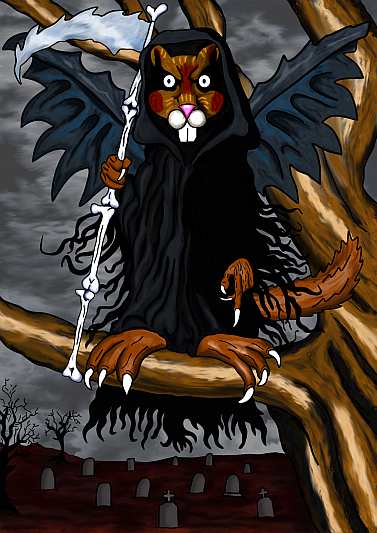
 Of the many supernatural threats facing this country, perhaps the most insidious is The Much Dreaded Chipmunk of Death.
This fluffy bastard, first described by puritan churchman Bloat Remington in his treatise “Satanic Fauna of the New World,” will go to great lengths to eliminate anyone who commits an offense against his fellow nut-biters. According to Reverend Remington, the beastie’s first recorded attack on a settler was in 1628, when a pilgrim named Goodman Jenkins, eschewing the local turkeys which he described as “the ugliest creature the Lord has ever sent to gross out his servants, with the possible exception of my mother in law,” opted instead for chipmunk, which according to him not only tasted much better than turkey but could also be used to make a useful pair of gloves for those cold New England winters. Three days after his first chipmunk supper, Jenkins’ decapitated body was found hanging feet first from the top of a neighbor’s barn — his head was later found floating in a cauldron of his wife’s famous Stone Soup, an irony which escaped nobody. At the time witnesses claimed to have seen a small, cloaked figure high up in a tree, where it seemed to be laughing or possibly knitting a sweater, nobody was quite sure.
Though this grim avenger has struck again many times over the years, two cases stand out, partly as they were documented by the media of the day, and partly because I can’t bother to do any more research…
In 1856, the Iowan Evening Register reported on the case of a farmer by the name of Milo Dungworth. Mr. Dungworth made the mistake of trying to eradicate the chipmunks on his property, not because he saw them as a threat to his crops but because he had been told by a local prankster that the state government had set up a chipmunk tax applicable to any property containing more than six of the creatures. One winter’s night, as he sat in his rocking chair browsing through the latest issue of The Critter Killer’s Almanac, the poor man heard what sounded like chittering coming from outside his window. Getting up and grabbing his shotgun, Mr. Dungworth went out into the darkened snowscape. As his wife watched from the window a dark shape, which she described as looking “Like a smaller version of my sister Janice,” swooped down and with one slashing motion sent the man’s head flying through the air, causing it to strike a low-flying owl. The last the woman saw of her husband’s hirsute assassin he was in a heated argument with the owl, who was threatening to call his lawyers.
According to a New York Times report from 1978, the furry fury does not restrict his vengeful activities to bipedal miscreants. We are told in the March 7th edition of the publication, that “Custard” was a yellow lab well liked around the local parks. Well liked, that is, except by the local chipmunks, whom he apparently saw as a rather quick if somewhat crunchy snack. According to his owner, one day while chasing his own tail — which he had no doubt mistaken for a chipmunk — poor Custard was plucked from the ground by what looked like “a hairy midget wearing a cloak” and not seen again till the following Wednesday, when his head was found placed on a rock, at the base of which had been scrawled in the unfortunate canine’s own blood the phrase “Sic Semper Tyrannis,” which I believe is Latin for “Don’t mess with chipmunks.”
The origins of this terrifying creature have never been explained. There is no mention of him in Native American folklore, and so it has been speculated that the creature came over from Amsterdam with the pilgrims. This seems an unlikely explanation as there are no chipmunks in the Netherlands, and consequently other sources have suggested the creature was already with the pilgrims when they left England, but this also seems unlikely as the last colony of English chipmunks was wiped out during the Black Pudding Rampage of 1576. A more probable explanation is put forward by Professor Joseph Ghast of the University of Massachusetts, who claims the creature is the ghost of a chipmunk who drowned after his dinghy was capsized by the Mayflower, and who thereafter dedicated himself to punishing all those who do harm to his fellow chipmunks. While this explanation leaves some questions unanswered — such as why the chipmunk went to the trouble of finding a dinghy when canoes were so readily available — it seems feasible enough to this writer, who from now on is planning on staying well away from anything even vaguely resembling a chipmunk, and that includes the Olsen twins.